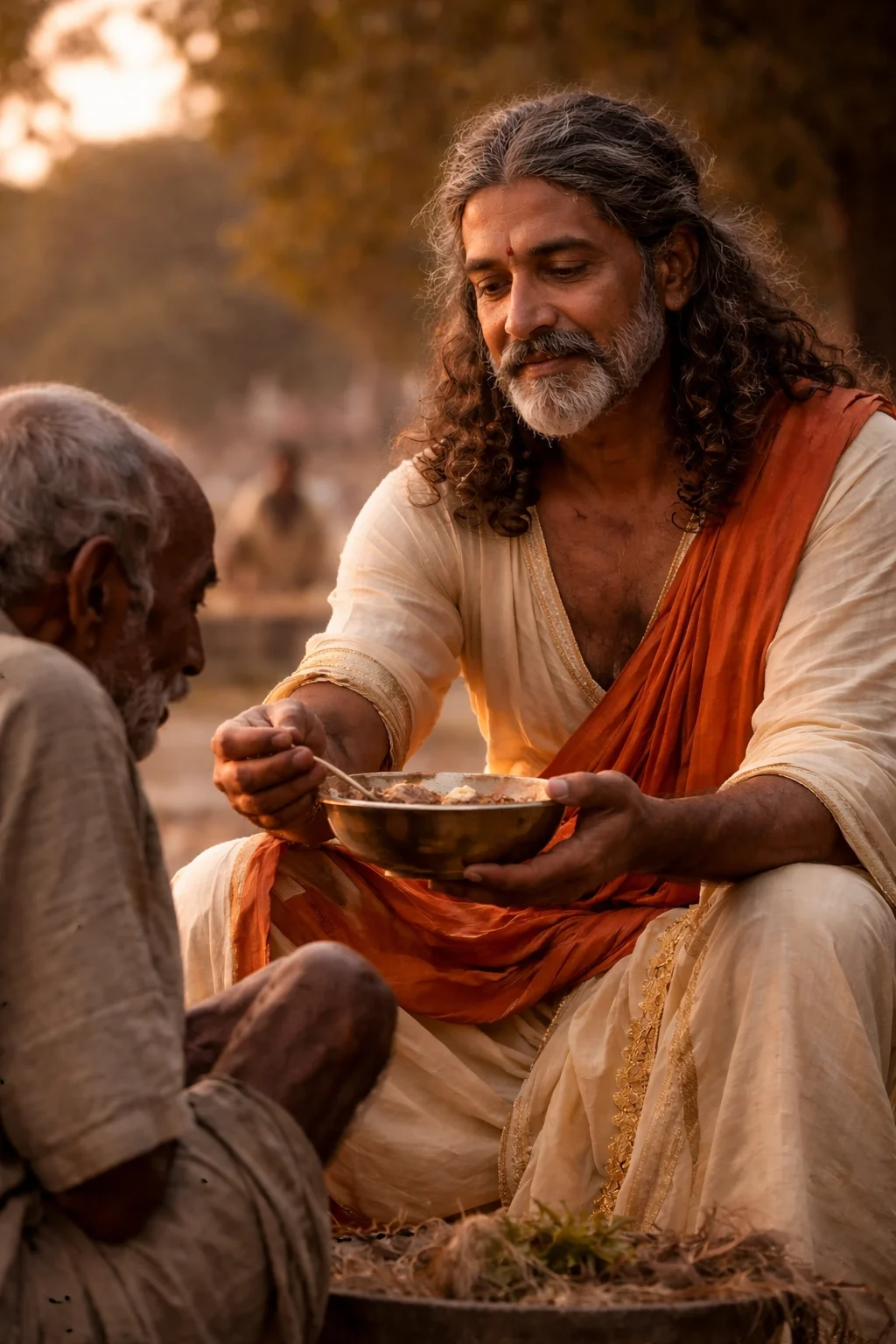
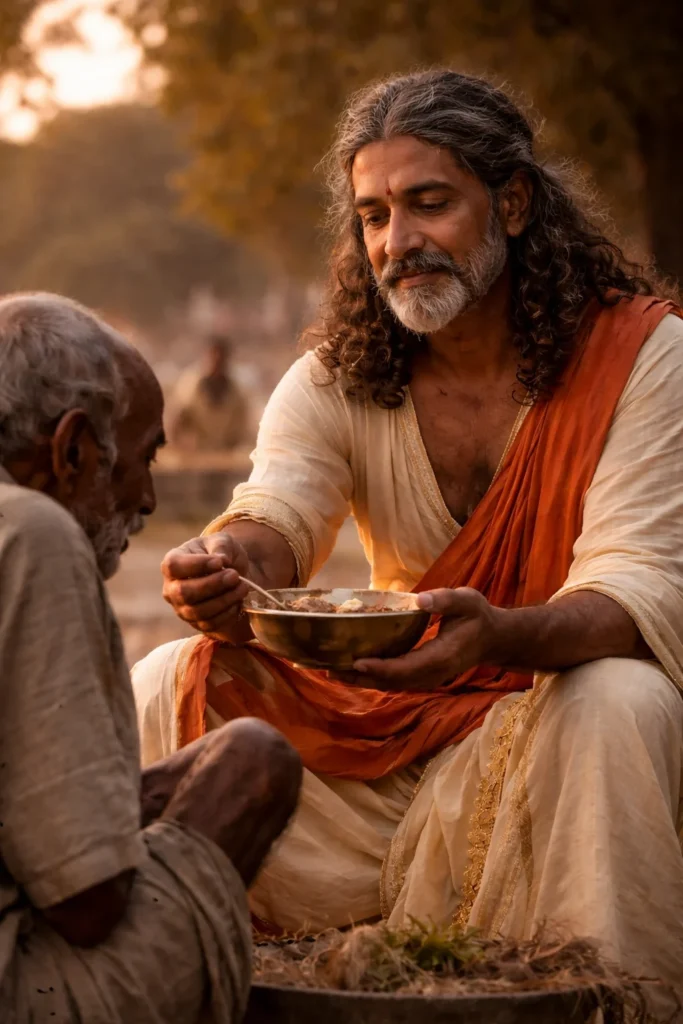
Forty-eight days without food. By now, hunger isn’t even the right word. It feels like your spirit’s loosening, quietly slipping out of your body.
The sun hung low, big and angry, pressing its heat down on what was left of the world. It wasn’t the burning kind that blisters your skin. No—it felt like a giant hand, squeezing the last bit of energy out of everything and everyone.
Even the wind had quit. The air pressed in, heavy as a soaked blanket.
That’s where Rantideva was. On that forty-eighth day, he chose to give away everything.
Inside what was once a beautiful palace, now broken and silent, Rantideva lay still. There was a time when powerful kings had bowed at his feet. Now, just breathing felt like a debt he could never repay.
No food. No water. Just a slow, grinding pain—like existence itself was wearing him away.
His family lay nearby, watching. Their lips were cracked, their eyes hollow. Hope had already gone somewhere else.
Then—footsteps. Hesitant, shuffling sounds. A servant slipped in, shaking, carrying something that didn’t belong—food. Not much, just enough for a single person. Water, catching the last bit of sunlight, looking like a promise.
The smell reached him first: warm grain, a touch of sweetness. Rantideva’s throat tightened. His body hadn’t forgotten what hunger was.
For a moment, his hand lifted, almost on its own. But then—knocking at the door.
A Brahmin stood there, thin as a shadow, his eyes pleading but quiet. He didn’t beg. He didn’t try to justify anything. He just stood.
Rantideva looked from the newcomer to the food. His fingers trembled, not just out of weakness, but from something else—decision.
He pushed the food forward. “Eat,” he said.
No second-guessing, no weighing options. The Brahmin ate, every bite a piece of Rantideva’s life handed over. Then he left.
The room grew heavier. His family stared—not in anger, but in shock. That was survival—gone.
Another knock. This time, a man rougher, even more desperate. His voice cracked; his breath reeked of want.
“Food, please…”
There wasn’t much left now—just scraps. Rantideva’s vision blurred at the edges, but he gave what remained without waiting. The man ate fast, scattering crumbs. When he finished, he was gone too.
One thing left: the water. A single vessel, still as a mirror. Rantideva picked it up—hands shaking hard, throat burning. This wasn’t just hunger now. This was death, waiting with patience.
A scraping noise at the door—different this time. A figure stood in the doorway. A pariah, skin split by the sun, covered in filth. Dogs circled him, thin and whining softly. Their eyes weren’t angry, just tired and needing.
The pariah spoke, barely loud enough to reach them. “I am thirsty.”
Something inside the room snapped. One of Rantideva’s family reached for him, voice breaking: “No…” It wasn’t protest. It was a plea. Live, just this once.
Rantideva looked from the water to the man and the dogs—lives trembling on a thread, not so different from his own.
He took a breath, slow and careful. And in that moment, everything shifted. This wasn’t just about life or death anymore, but about whose life counted.
He smiled, not weakly—something else, something almost afraid. He walked to the man, every step cracked and shaky, and pressed the water into the pariah’s hands.
“Drink,” he said.
The man hesitated—something silent, heavy between them. Then he drank. The dogs licked what was left.
The cup emptied.
Silence.
Rantideva staggered. The world tilted. His body started giving up at last. But his eyes—clear, brighter than ever.
Then, things changed. The heat disappeared. The pariah straightened, and the filth vanished. Even the dogs shimmered. Light flooded in, impossible and blinding.
The beggar was gone. Gods stood in his place: vast, radiant, unendurable. They’d come disguised, testing, waiting for him to fail.
One of them stepped forward—his voice thunder and velvet at once. “Ask,” he said. “Power, heaven, freedom.”
Rantideva didn’t bow. He didn’t look surprised. He actually laughed, as if the very question was beside the point.
“I don’t want heaven,” his voice quiet but strong enough to fill the room. “I don’t want power. I don’t even want freedom.”
He looked at them—not as gods, but as others, just like him.
“All I want is to abide in every being. To feel their hunger, their thirst, their suffering—and to bear it, so they don’t have to.”
Silence. But not an empty one. Something vast lived in it.
For the first time, the gods couldn’t offer anything. Rantideva’s body finally let go.
He fell. But his face didn’t show pain—just something deeper. Peace.
As his last breath slipped away, something else arrived. It didn’t come from above or below—it was everywhere, all at once.
In that instant, Rantideva didn’t become a king again. He didn’t take back his power. He didn’t vanish either.
He simply spread out.
He became the hunger.
He became the thirst.
He became every ache that cries out in the dark.
And even now… when somewhere, one stranger feeds another with what little strength they have left, there’s a spark. A presence. A warmth that’s almost impossible to find.
As if, even now, someone out there is still choosing to go hungry—so the world doesn’t have to.